AC Running But Not Cooling: What to Check and When to Call
Some causes take a minute to check and fix, and others need gauges and tools.
October 13, 2026 · 4 min read
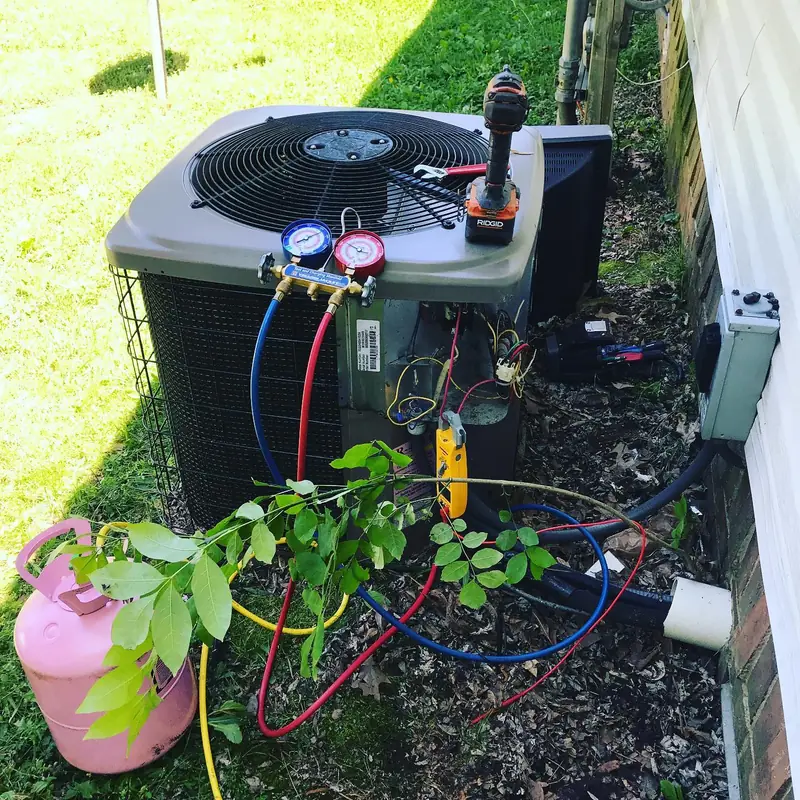
The system is running. You can hear the fan and feel air coming out of the vents. But the house is not getting any cooler. That is frustrating, and on a humid Middle Tennessee afternoon it is also uncomfortable. The good news is that a handful of causes are easy for a homeowner to check. The others call for a technician, and knowing which is which saves you time and a lot of guessing.
Start with the thermostat
It sounds obvious, but a surprising number of cooling calls end at the thermostat. Make sure it is set to cool, not heat or fan only, and that the temperature is set below the current room temperature. If the fan is set to on instead of auto, air will blow continuously, and when the compressor is off that air will feel lukewarm. Dead batteries can also cause odd behavior in thermostats that use them.
Check the filter and the airflow
A clogged filter is the most common cause of weak cooling that a homeowner can fix. Restricted airflow means less cold air reaches the rooms, and in some cases the indoor coil can freeze over. Pull the filter and look at it. If it is gray and matted, replace it. This is why Master Mechanical's tip to change the filter monthly is worth following.
While you are at it, check that the supply vents and return grilles are open and not blocked by furniture, rugs or curtains. Look at the indoor unit if it is accessible. Ice on the refrigerant line or on the coil means the system is frozen. In that case, turn cooling off at the thermostat, switch the fan to on so air moves across the coil, and give it time to thaw before trying again. A freeze usually has a cause behind it, such as low airflow or a refrigerant problem, so a repeat freeze is a reason to call.
Check the breaker and the outdoor unit
Air conditioners often have two breakers or a dedicated one for the outdoor unit. If the indoor fan is blowing but the outdoor unit is silent, a tripped breaker may be the reason. Reset it once. If it trips again, stop. A breaker that keeps tripping is telling you something is wrong electrically, and forcing it is not a fix.
Then step outside and look at the condenser. Is the fan turning? Is the cabinet buried in shrubs, leaves or clippings? A coil coated in debris cannot shed heat, and the system will run without cooling well. Clear what you can reach by hand, and with the power off at the disconnect, rinse the coil gently with a garden hose. Do not use a pressure washer.
- Thermostat set to cool, with a target below the room temperature.
- Air filter clean and seated correctly.
- Vents and return grilles open and unblocked.
- No ice on the coil or refrigerant line.
- Breaker on and not repeatedly tripping.
- Outdoor fan turning and the coil free of debris.
When it needs a technician
If everything above checks out and the house still will not cool, the cause is likely inside the sealed or electrical side of the system. Three common ones are a low refrigerant charge, a failed capacitor and a worn contactor.
Refrigerant circulates in a closed loop and is not used up like fuel. If the charge is low, there is usually a leak somewhere. Reading the charge properly takes a manifold gauge set and an understanding of the pressures and temperatures involved, which is why a technician connects gauges to the system rather than guessing. Adding refrigerant without finding the leak only delays the problem.
A capacitor is a small canister that gives the fan motor and compressor an electrical boost to start and run. When it weakens, you may hear humming without the fan spinning, or the compressor may struggle to start. The contactor is the heavy switch that sends power to the outdoor unit. If its contacts are worn or pitted, the unit may not start or may chatter.
What not to do
Do not open the electrical panel on the outdoor unit. A capacitor can hold a charge even after the power is switched off, and the wiring in there is not forgiving. Do not add refrigerant yourself, and do not keep forcing a system that is freezing, humming or tripping a breaker. Running it in that state can turn a small repair into a bigger one.
Master Mechanical is a locally owned and operated company in Spring Hill, Tennessee, handling residential and commercial heating and air across Middle Tennessee. If you have been through the checks above and the house is still warm, call (615) 562-2525 and describe what you found.
Master Mechanical, (615) 562-2525
Call (615) 562-2525More articles
Change Your Air Filter Monthly: Why Such a Small Job Matters
The cheapest thing you can do for your heating and cooling system takes less than a minute, and most people put it off.
Give Your Outdoor Unit Room to Breathe
The big metal box beside your house moves a lot of air, and it needs open space around it to do that job.