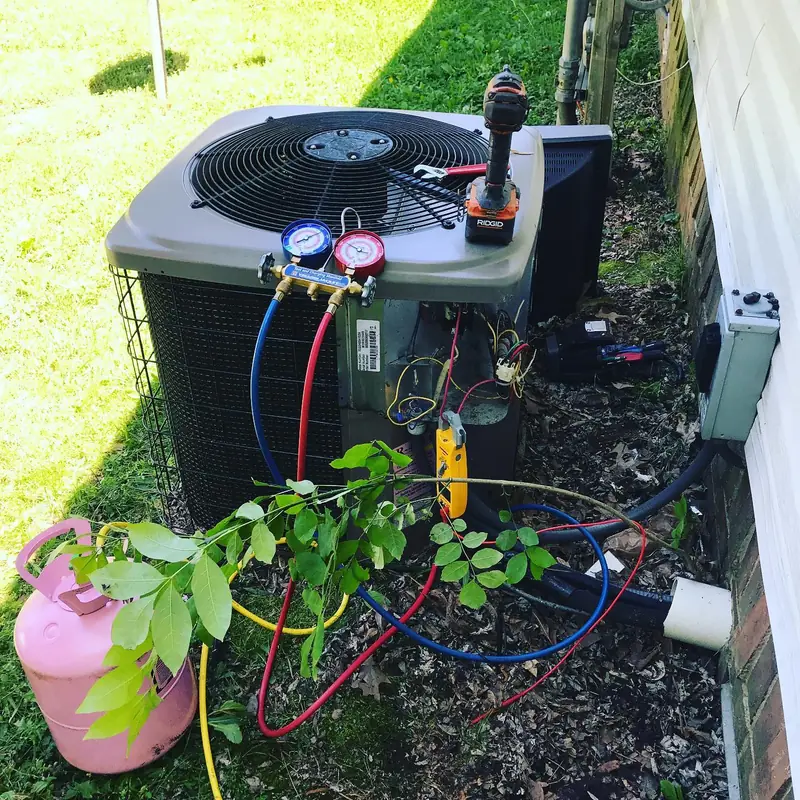
A condenser that runs but never cools the house
When the outdoor fan spins and the compressor hums but the air at the vents stays warm, the system is running without doing its job. In Spring Hill and Columbia homes the usual suspects are a low refrigerant charge, a failed run capacitor that cannot start the compressor properly, or a filter so clogged that the indoor coil is starved of air. Each one looks identical from the thermostat.
Capacitors are small cylinders that give the fan motor and compressor a jolt to start and keep them turning. They wear out slowly and then fail all at once, often on the first hot afternoon of the year. A low charge is different: refrigerant is not used up, so a system that is short has a leak somewhere, and topping it off without finding the leak only buys time.
Airflow problems are the quiet ones. A packed filter or a coil furred with dust makes the blower work harder while moving less air across the coil, so the house cools slowly and the coil can even freeze over. If your system behaves like this anywhere in Middle Tennessee, a call to (615) 562-2525 gets someone out to read what the unit is actually doing.
Gauges on first, parts second
Before anything gets replaced, the crew hooks a manifold gauge set to the service ports on the outdoor unit. The low side, the blue hose, and the high side, the red hose, show what the refrigerant is doing at the compressor, while the yellow hose is the charge line. Those pressures, read against the outdoor temperature, say whether the charge is right or the trouble sits somewhere else.
Then the electrical side gets checked: the capacitor is tested against its rating, the contactor is inspected for pitting, and the wiring to the disconnect and control box is looked over. Measuring each part means you are told which one is bad, rather than handed a full replacement because nobody checked. The habit is the same on a service call in Columbia as on a new package unit set beside a new brick home.
Installation and replacement follow the same order. The pad is set level, the line set is connected, and the system is charged and measured before the crew leaves, with the gauges back on the unit to confirm the numbers. Master Mechanical does this for residential and commercial properties, and the crew has worked out of Spring Hill since 2014, one phone call for heat and air, plumbing, electrical and gas.
What keeps a condenser alive after we leave
The cheapest thing you can do for your system is change the air filter every month. A clean filter lets the blower move the air it was sized to move, which keeps the coil from icing and the motor from straining. It takes a minute, costs very little, and does more for performance and efficiency than any other habit. Set a reminder on your phone and keep spares beside the return.
Outside, give the condenser room to breathe. Clear back bushes and shrubs that could grow into the system, and keep grass clippings and leaves from piling against the coil. Covering the unit with an awning or an enclosure can help it last longer, as long as the cover does not close off the airflow at the sides or over the fan.
If the unit starts behaving differently, such as short cycling, ice on the lines or a breaker that trips when it starts, say something sooner rather than later. A small fault caught early is often a capacitor or a cleaning. Left alone through a Middle Tennessee summer it can become a failed compressor. Call (615) 562-2525 or email service@mastermechanicaltn.com and describe what you see.